If you’ve spent any time researching this question, you’ve probably noticed something: almost every article comparing 3PLs and 4PLs is written by a logistics provider and they tend to nudge you toward whichever model they happen to sell. That’s not a criticism; it’s just how it is. It makes the comparisons less useful than they should be.
We’re not a 3PL or a 4PL. We advise businesses on how to structure their supply chains, which means we don’t have a dog in this fight. So here’s the straight version.
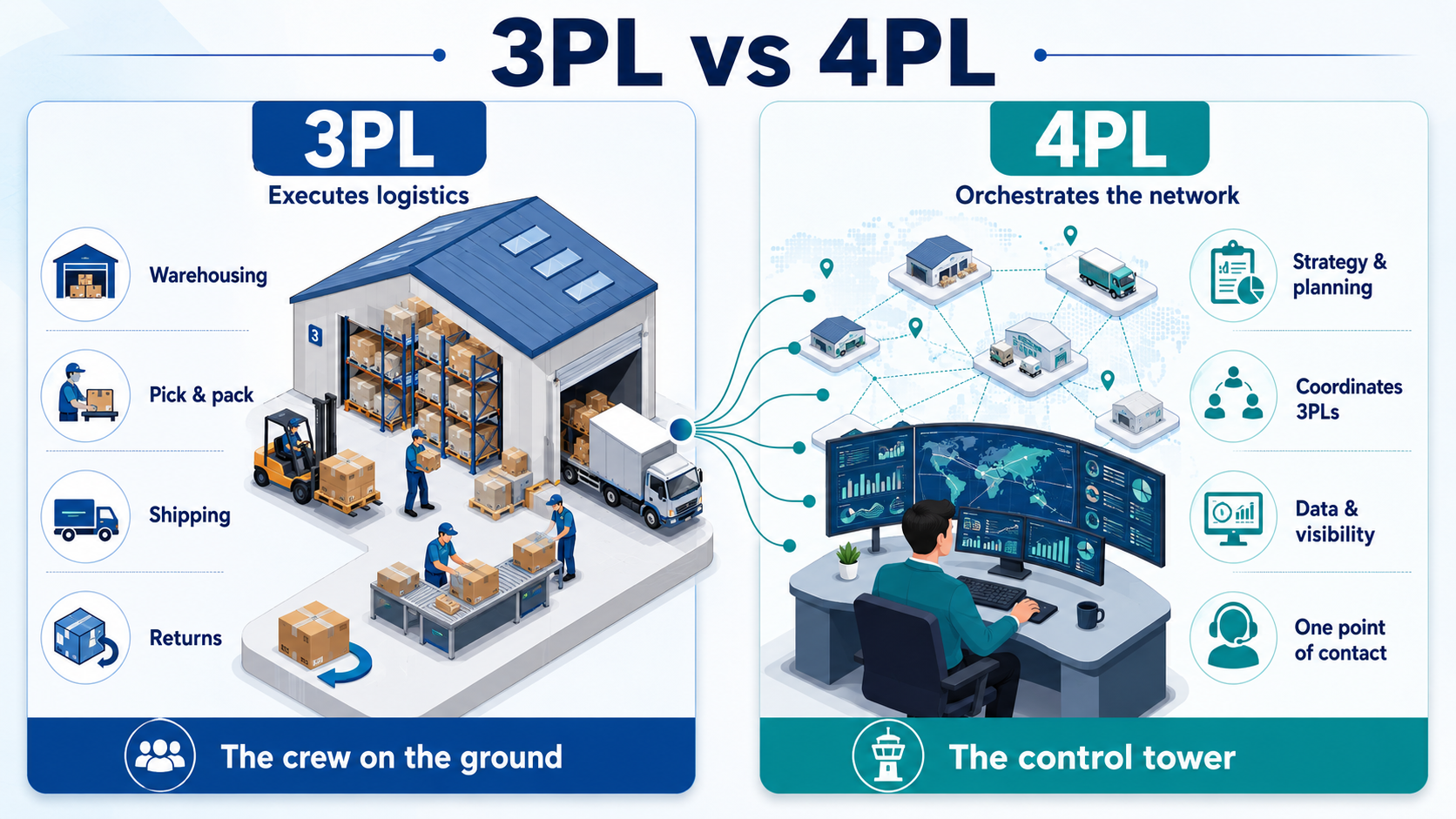
The quick answer: a 3PL executes logistics on your behalf – warehousing, picking, packing, shipping. A 4PL sits a level above that, managing the overall strategy and coordinating one or more 3PLs so you have a single point of contact for the whole network. One does the work; the other directs it.
What is a 3PL?
A third-party logistics provider (3PL) handles the physical and operational side of your supply chain: storing inventory, picking and packing orders, arranging shipping, and managing returns. Most 3PLs own their own infrastructure – warehouses, vehicles, and staff – which is part of why they can be cost-competitive. You’re essentially renting capacity and expertise that would be expensive to build yourself.
Think of a 3PL as the team actually moving boxes, running the warehouse floor, and getting orders out the door.
What is a 4PL?
A fourth-party logistics provider (4PL) doesn’t typically own trucks or warehouses. Instead, it acts as a strategic layer above your logistics network – coordinating multiple 3PLs, integrating the technology and data that ties them together, and taking ownership of end-to-end planning. A 4PL is often described as a “control tower”: one point of contact responsible for how the whole network performs, even though someone else is doing the physical work.
If a 3PL is the crew on the ground, a 4PL is the person running the operation from above, making sure all the crews are pointed in the same direction.
3PL vs 4PL: The Core Difference
Strip away the jargon and it comes down to this: 3PL is execution and assets. 4PL is strategy and orchestration.
| 3PL | 4PL | |
|---|---|---|
| Scope | Warehousing, fulfilment, transport | Network strategy, coordination, planning |
| Assets | Usually owns warehouses, vehicles, staff | Usually asset-light |
| Control | You manage the relationship directly | 4PL manages it on your behalf |
| Point of Contact | Often one 3PL per function or region | Single point of contact across all providers |
| Technology | Provides operational systems (WMS, TMS) | Owns data integration and end-to-end visibility |
| Cost | Generally lower, more price-competitive | Higher, includes a management/coordination fee |
| Relationship | Transactional to semi-strategic | Deeply strategic, long-term |
| Best for | Single-region, moderate complexity operations | Multi-provider, multi-region, high-complexity networks |
How Each Model Works in Practice
A 3PL relationship typically runs in a straightforward loop: your inventory arrives at their facility, gets stored, and then flows through pick, pack, and ship as orders come in -with returns handled on the way back. You’re plugged directly into their operation.
A 4PL relationship looks different. It starts with network-level planning – figuring out which partners should serve which regions or functions. From there, the 4PL orchestrates those partners day to day, gives you unified visibility across all of them through a shared technology layer, and coordinates delivery performance across the board. You’re not managing five separate relationships – you’re managing one.
Cost: 3PL vs 4PL
A 4PL adds a management layer, and that layer isn’t free – you’re paying for coordination, technology, and strategic oversight on top of whatever the underlying 3PLs charge. That also means less direct price competition, since the 4PL is negotiating on your behalf rather than you shopping providers yourself.
A 3PL is usually the more economical route in pure cost terms. But “cheaper” isn’t the same as “better value” – it depends entirely on what your team is actually capable of managing in-house. If coordinating multiple providers is quietly eating a manager’s week every month, that hidden cost is real too, even if it never shows up on an invoice.
How to Choose: A Decision Framework
This is really the question that matters, and it doesn’t have a universal answer. A few things tend to decide it:
- Growth stage – earlier-stage or single-region businesses rarely need the coordination layer a 4PL provides.
- Operational complexity – the more moving parts (multiple warehouses, carriers, or fulfilment types), the more a 4PL’s orchestration earns its keep.
- Number of partners and regions – one 3PL is easy to manage directly; five providers across three continents is a different problem entirely.
- Control preference – some businesses want to stay close to operational decisions; others want it off their plate.
- In-house capability – if you already have strong logistics and planning talent internally, you may only need execution partners (3PLs), not a strategic layer on top.
There’s no prize for choosing the more sophisticated-sounding model. The right answer is whichever one matches the complexity you’re actually dealing with today.
Can a 3PL and a 4PL Work Together?
Yes – and this is where a lot of the “versus” framing online gets misleading. These aren’t competing options you pick between once and stick with forever. In a combined model, the 4PL provides strategic governance and a single point of accountability, while the 3PLs underneath it handle the day-to-day warehousing, picking, and shipping. Each does what it’s built to do.
The “3PL vs 4PL” framing sells more content than 3PL and 4PL, depending on the layer, but in practice, plenty of well-run supply chains use both at once.
How PerformanSC Helps
We’re not trying to sell you a warehouse or a control tower but we help you work out which structure actually fits your business, and how to set it up so it holds together as you scale. That’s the advantage of talking to someone who isn’t selling either model: the recommendation is about your operation, not our balance sheet.
If you’re weighing this decision for your own network, we’re happy to talk it through. [Get in touch with our team.]
FAQs
What’s the difference between a 3PL and a 4PL?
A 3PL executes logistics – warehousing, picking, packing and shipping – and usually owns the assets. A 4PL sits above it, managing strategy and coordinating one or more 3PLs as a single point of contact. In short: 3PL is execution, 4PL is orchestration.
What do 1PL, 2PL, 3PL, 4PL and 5PL mean?
Each step adds a layer. A 1PL moves its own goods. A 2PL owns the transport, like a carrier. A 3PL outsources fulfilment operations. A 4PL manages the 3PLs and overall supply chain strategy. A 5PL designs and optimises entire logistics networks, often across multiple clients at once.
Is a 4PL more expensive than a 3PL?
Usually, yes. A 4PL adds a management layer with its own fees or revenue share, and it reduces the direct price competition you’d get negotiating with 3PLs yourself. A 3PL tends to be more economical for businesses that can manage those provider relationships in-house.
Should my business use a 3PL or a 4PL?
Most businesses – especially early-stage or fast-growing ones – are well served by a strong 3PL. A 4PL tends to make sense at larger scale, once you’re coordinating multiple providers, regions, or systems and are willing to trade some hands-on control for centralised oversight.
Can a 3PL and a 4PL work together?
Yes – they’re complementary, not either/or. In a combined model, the 4PL provides strategic governance and coordination while the individual 3PLs execute the day-to-day warehousing, picking, and shipping.
When should a business move from a 3PL to a 4PL?
Typically when logistics get too complex to manage in-house – juggling several fulfilment partners, expanding into new international markets, or needing one centralised layer to control strategy, performance, and technology across the network.
Supply Chain Enabled