AI is already transforming how supply chains plan, operate and respond to disruption. Not in theory. In practice, right now, across manufacturing, food, pharma and retail. Companies are making faster decisions, catching risks earlier, automating processes that used to take days and building operations that can adapt in real time to what is actually happening in the world.
What is less talked about is how they got there.
Because behind every successful AI implementation there is a foundation that most articles skip over. And understanding that foundation is actually what separates the organisations seeing real results from the ones still waiting for the technology to deliver on its promise.
The path to intelligent supply chain operations is real and it is closer than most companies think. The key is building it in the right order so that each step creates the conditions for the next one to work.
A Phased Approach to AI in Supply Chain
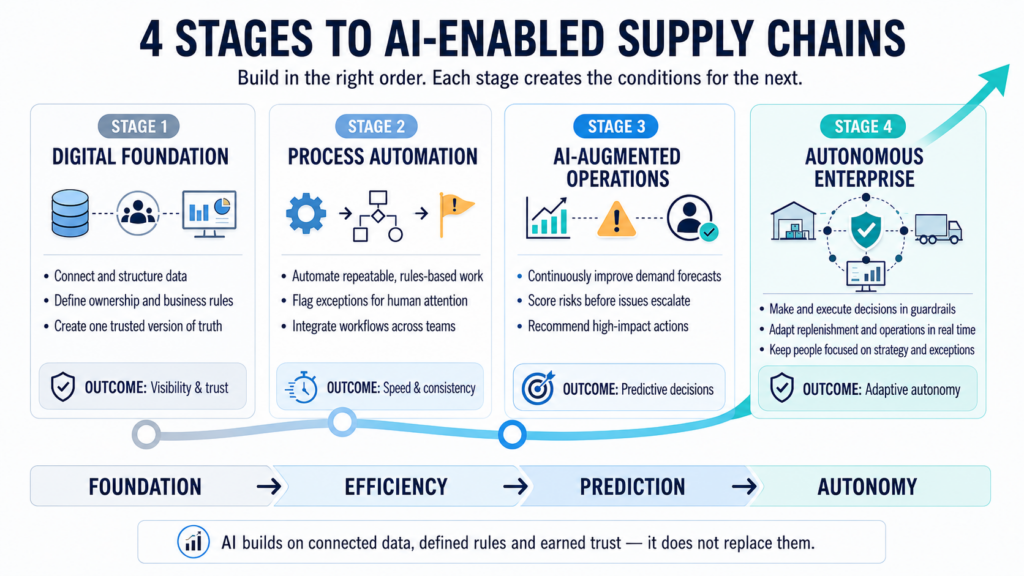
Based on our work across manufacturing, food, pharma and retail we have mapped a supply chain digital transformation journey that moves through four stages. The pace is different for every organisation, but the logic of the sequence holds across industries.
Stage 1: Digital Foundation
This is the stage that takes the most time and the most stakeholder involvement. And that is not a problem, it is the point.
Before any tool, any dashboard or any automation, you need to understand where your data lives, who owns it, what the business rules are and how decisions are actually being made today. That means spending real time with the people doing the work. Planners, quality teams, warehouse managers, IT. Mapping the processes, understanding the exceptions, documenting the logic that currently lives in someone’s head. You cannot automate rules you have not defined, and you cannot connect data you do not understand.
The output of this stage is a connected, structured data model with a single version of the truth that all teams work from. Common definitions across systems. Basic dashboards that give visibility into what is actually happening without manual reconciliation. And decisions that start moving away from email chains and personal spreadsheets toward something the whole organisation can trust.
The benefits here are more significant than people often expect before they experience them. Teams that used to spend days reconciling data now have it available in real time. Departments that used to work from different versions of the same information now work from one. And conversations that used to be arguments about whose numbers are right start becoming conversations about what to do next. That shift alone changes how an organisation operates.
Stage 2: Process Automation
With a solid foundation in place the next step is removing the manual, repetitive work that is still happening around it. This is where the process understanding from stage 1 pays off because you now know the rules well enough to automate them reliably.
Rules based automation standardises how decisions get made for routine situations. Exception handling means the system flags what needs human attention rather than requiring someone to check everything manually. Workflow integration connects processes that previously relied on emails, phone calls or manual handoffs between teams.
The benefits at this stage are immediate and measurable. Processes that used to take hours now run in minutes. Human error in routine tasks reduces significantly because the rules are applied consistently every time. Teams that were spending most of their time on data gathering and manual checking now spend that time on the decisions and exceptions that actually need human judgment.
This stage also does something that is easy to underestimate. It builds confidence. When people see a process running reliably and consistently, when they stop having to do the repetitive work and start seeing accurate outputs they can act on, trust in the system grows. That trust is what makes the next stages possible.
It is worth saying clearly that stages 1 and 2 deliver significant operational value on their own. Many organisations see their biggest improvements at these stages. AI builds on that foundation, it does not replace it.
Stage 3: AI-Augmented Operations
This is where the intelligence layer comes in. And one of the most important things about approaching it this way is that by the time you reach stage 3 the conditions for AI to actually work are already in place.
The data is clean, connected and trusted. The business rules are documented and understood. The team has been involved from the beginning and knows the logic behind the system. That matters enormously because AI recommendations are only useful if the people receiving them understand enough of the context to trust and act on them.
At this stage the system starts doing things that were not possible before. Demand forecasting that accounts for multiple variables simultaneously and updates continuously as conditions change. Risk scoring that combines data from across the supply chain to flag potential issues before they become problems. Predictive insights that tell planners not just what is happening, but what is likely to happen next and what action will have the most impact.
The shift from stage 2 to stage 3 is the shift from reactive to predictive. Instead of the system showing you what happened and flagging exceptions after the fact, it starts surfacing risks and recommendations before the problem occurs. Planners move from managing the present to actively shaping what happens next.
And because the team has been part of the journey from the beginning, they are in a position to question recommendations when something does not look right, investigate when the system flags something unexpected and continuously improve the logic based on real outcomes. That feedback loop is what makes the system get smarter over time rather than staying static. If you want to go deeper on specific AI applications in supply chain planning and optimisation, we have covered that in more detail in AI-driven supply chain optimisation.
Stage 4: Autonomous Enterprise
The end state is a supply chain that can make and execute many of its own decisions within defined guardrails, with people focused on strategy, exceptions and continuous improvement rather than routine transactions.
In practice this looks like a demand planning system that detects a supply disruption and adjusts replenishment orders without waiting for a planner to notice. A warehouse operation that optimises pick routes and staffing in real time based on what is actually arriving and what needs to go out. Decisions that used to take hours of manual analysis happening in seconds, with full reasoning and traceability behind each one.
The people in these organisations are not redundant. They are doing different work. Reviewing the exceptions the system could not resolve confidently. Improving the rules based on outcomes. Focusing on the strategic decisions that genuinely need human judgment rather than the operational ones that the system can handle reliably.
This is already happening in some organisations, and it will reach more of them faster than most people expect. But it is built entirely on what came before. The connected data, the standardised rules, the trust that was built progressively through the earlier stages. There is no shortcut here that works sustainably. And reaching it sustainably comes down to one thing more than any other. How you brought your people along the way.
Why Building in Phases Keeps Everyone Moving
One thing that I often see that gets overlooked in transformation conversations is the human side of momentum. When a system arrives fully formed without the team being part of building it, the outputs can feel disconnected from reality. Not because the technology is wrong but because the context that makes recommendations meaningful was never shared. That disconnect is usually where momentum breaks down.
When you build in phases every stage produces something visible and useful. The team sees the data get cleaner. They see the reports become reliable. They see the manual work reduce. By the time the more advanced recommendations start appearing they have the context to understand and act on them. That is how you build internal capability that stays inside the organisation and keeps compounding over time. Every organisation is at a different point on this journey. The most useful question is not how far from you are from the end state, but what the next step looks like from where you are today.
If you are thinking about where your organisation sits on this journey and what the next step looks like, that is the conversation we have with clients every day. You can find out more about how we work supply chain consultants
Supply Chain Enabled