Nothing replaces experience, but operations research provides much-needed analytical rigour to decisions
Take an experienced operations manager onto a warehouse floor and they will tell you what is wrong with it before you have finished setting up your laptop. Congestion at the wrong end of the building. Too much space given to slow movers. A dock that cannot cope with the arrival profile. That judgement is real, it is fast, and nothing replaces it. Rules of thumb get a bad name, but they are experience compressed into something you can use as a starting point.
What experience does not always give you is the number. It will tell you a site is running out of space. It will not tell you when, by how much, or what the alternatives cost. The changes required to fix it frequently have to be justified to someone holding a budget. That gap is where operations research (OR) earns its place in warehouse design.
Where I am coming from
I came to these problems with a strong academic background, including a Master’s in Supply Chain Management. It is fair to say that I met operations research on paper first. Formulations, objective functions, optimal solutions to problems that had been tidied up before they ever reached me. I was genuinely unsure how much of it would survive contact with a live project, or whether OR was going to turn out to be a set of exam questions rather than a set of tools.
Nine months into a consulting career working within an experienced team, my answer is that it survives better than I expected, though not in the shape it was taught. Enter the world of imperfect data, tight deadlines and the need to think outside the box to frame a client requirement into a solution definition and practical approach.
What operations research is, and how wide it goes
Strip away the textbook definition and operations research is a set of methods for making decisions where there are too many possible answers to check by hand. You describe the problem in numbers, describe what good looks like, and let the maths do the searching.
The field is considerably broader than the corner of it I work in. Linear and integer programming for allocation and scheduling problems. Discrete event simulation wherever timing, variability and queuing matter. Network optimisation for flow and routing. Inventory theory for stock policy. Queuing theory, heuristics and metaheuristics for the cases where an exact answer is out of reach and a very good one will do. Forecasting sits alongside all of it, since it produces the input most of these models depend on.
Across our client projects at PerformanSC we now have 92 working OR models. That number did more to change my mind about the breadth of this than any single project did. Network design, capacity planning, layout and flow, inventory policy, transport, resourcing. The common thread is not the industry or the software. It is that a decision was being made with real money behind it, and someone wanted evidence to support it.
Three OR models I use in warehouse design
Capacity models answer how much space an operation genuinely needs. Not one number, but a range that moves with stock profile, stacking height, racking type and seasonal peak. What people find most useful is rarely the headline figure. It is seeing the requirement move by thousands of pallet positions on assumptions nobody had written down before.
Facility location models answer where a site should sit, given where demand and supply actually are. A weighted centre of gravity is a starting point rather than an answer, but it is a good way of establishing whether the location everyone has already settled on is defensible.
Warehouse layout design is where the optimisation view changes the conversation most. A layout looks like a drawing problem and is really an allocation problem: which SKUs sit in which pick face type, how much footprint goes to reserve versus pick, how wide the aisles need to be, where the fast movers sit relative to despatch. Each choice trades off against the others, and travel distance ties them together. Draw it by hand and you get a layout that works. Model it and you can compare the one you drew against the four you did not.
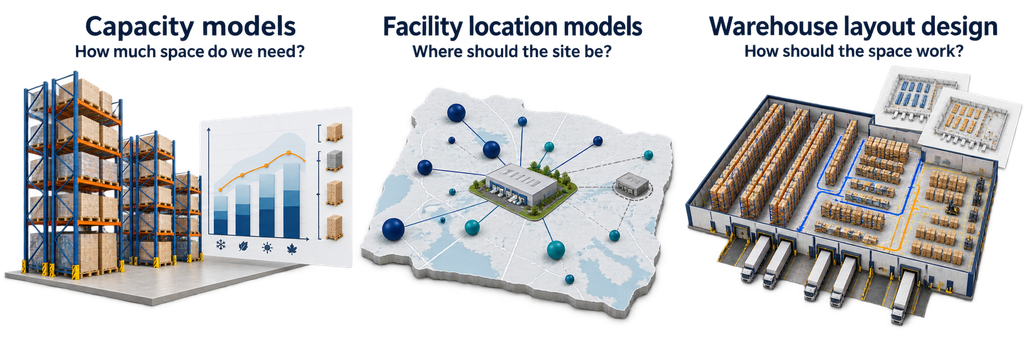
What the models are for in warehouse design
The most common outcome is not that the model contradicts the experienced view. More often it agrees with it, and the agreement now has a number attached.
That turns out to matter a great deal. An extension, a new site, a racking reconfiguration and an automation case all compete for the same capital, and none of them get signed off on a well-informed opinion. A model showing the space requirement crossing the current footprint in year three is a different conversation to an operations manager saying the site feels tight.
Same conclusion, very different weight.
What digitalisation and AI changed
None of these methods are new. What has changed is how quickly you can build them and how easily you can show them to someone.
I have been working with a warehouse digital twin that lets me draw a layout and then run a discrete event simulation over it. The combination matters more than either half on its own. A capacity model tells you whether the space works. A simulation tells you whether the operation works inside that space, with real arrival patterns, dock constraints and congestion. It is also where queuing theory stops being a lecture topic: model truck arrivals as a distribution rather than an average, and queues appear at gates and docks that an average would never have exposed.
The presentational side is not a minor benefit either. A spreadsheet model is something a client takes on trust. A model they can watch run, with pallets moving through their own layout, is something they can argue with. Being argued with is how a model gets better.
AI has genuinely accelerated the building of better tools to address these problems. Data preparation still absorbs most of the time on any of these projects, and that is exactly the messy, repetitive work it helps with. It shortens the distance from an idea for a model to a working version of it.
The caution I would offer is about reliance. It would be easy to let an LLM write the model and then take the output on faith. A learning from working within an experienced consulting team is that the disciplines are in place to challenge any approach, and to understand and replicate it from first principles. Faster development does not remove the need to fully understand and validate a model. The formulation still has to be right, and the assumptions still have to be checked before any of it gets used in our work.
Where I think this ends up
Not with models replacing judgement. The useful version of this is the one where experience does what it is best at, which is asking the right question quickly and knowing when an answer looks wrong, with OR underneath it supplying the numbers.
That combination is stronger than either half. Nine months in, the learning curve remains steep, but the disciplines and the approach are becoming familiar. The power of real-world data in giving quantitative answers to operational problems is a clear advantage in accelerating good warehouse design decisions.
Weighing up an extension, a new site or a layout change? Talk to our warehouse consulting team about modelling the options before the capital is committed.
FAQs
What is warehouse design?
Warehouse design is the process of deciding how much space an operation needs, where the site should sit, and how that space is laid out: pick faces, reserve storage, aisle widths and where fast movers sit relative to despatch. Each choice trades off against the others, which is why it benefits from modelling rather than drawing alone.
How is operations research used in warehouse design?
Operations research uses mathematical models to compare options that are too numerous to check by hand. In warehouse design the most common are capacity models, facility location models and layout optimisation models, often combined with discrete event simulation to test how the operation performs over time.
What is the difference between a capacity model and a warehouse simulation?
A capacity model tells you whether the space works. A simulation tells you whether the operation works inside that space, with real arrival patterns, dock constraints and congestion.
Can a digital twin help with warehouse design?
Yes. A warehouse digital twin lets you draw a layout and run a simulation over it, so you can watch pallets move through the proposed design, test it against real arrival profiles and compare alternatives before committing capital.
Supply Chain Enabled