
Dr. Tony McVeigh, Principal, Operations
Tony brings four decades of senior experience in international manufacturing and distribution, including roles as Managing Director Europe and Chief Operating Officer. With PerformanSC since its inception, he leads our Operations Research function. He holds a Doctorate in Applied Mathematics and is a Chartered Engineer.
Keeping Production Lines Supplied
Picture the scene …
It is mid-morning on a busy assembly line, and production has abruptly stopped.
The material planners are chasing a supplier for a component that, according to the system, has not yet arrived. In fact, the part has already been on-site since the previous evening; it is sitting in an unopened trailer in the yard, waiting to be received.
This scenario is more common than many manufacturers would perhaps care to admit, and, without doubt, it highlights a simple truth: a delivery is not complete when it reaches the gate; it is only complete when it reaches the line.
This short article examines inbound logistics in manufacturing, asks why production sites are the first to experience inbound failures, and discusses the practical steps that bring the inbound flow back under control.
What Is Inbound Logistics in Manufacturing?
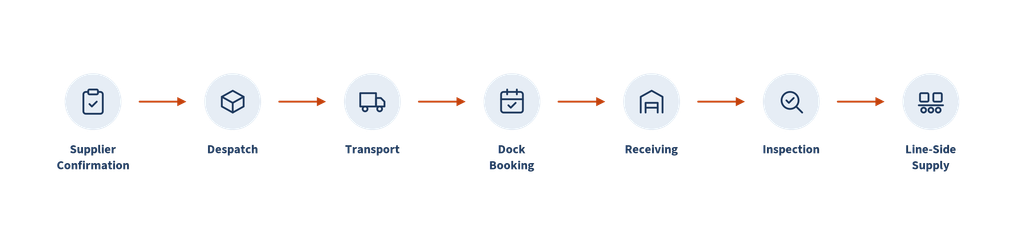
Simply put, inbound logistics covers everything that brings materials from suppliers to the point of use, together with the information that travels with them. Inbound flows typically occur in the following sequence:
- Supplier Confirmation
The supplier formally accepts the Purchase Order (PO) and commits to quantity, price, delivery date and Incoterms. Any differences are flagged at this point rather than at the dock - Despatch
Goods are picked, packed and labelled at the supplier location, then handed to the carrier. The Advance Shipping Notice (ASN) tells the warehouse what is coming before it arrives - Transport
Transportation modes may be road, sea, or air
Goods move from origin to destination, by one mode (road, sea, and air) or several - Dock Booking
The carrier or supplier reserves a warehouse time-slot so arrivals are spread across the day, matched to dock and labour capacity - Receiving
Goods receipt is recorded against the PO
Goods are unloaded, checked against the ASN or PO, and Goods Receipt (GR) is posted in Enterprise Resource Planning (ERP) or Warehouse Management System (WMS) . Stock is now on the books, and the supplier’s invoice can then be matched - Inspection
Quality checks run before goods are released to operations. Stock is usually received into a quarantine (or QI-status) so that items do not get consumed before being approved - Line-Side Supply
Released material reaches the point of use; there are two routes – either putaway to storage locations first, or go straight to the line
Clearly, any weakness that occurs at any one of these stages will likely ripple downstream; quite often, we find that the cause actually lies in the information rather than the physical goods.
Inbound vs Outbound Logistics
Inbound logistics brings materials into the business; outbound logistics moves finished goods out to customers. For a manufacturer, inbound covers supplier orders, transport, receiving and line-side supply, while outbound covers finished goods storage, order picking, despatch and delivery. The two often share the same docks, labour and systems, so congestion on one side quickly affects the other. This article focuses on the inbound side, because that is where production sites feel failures first.
Why Manufacturing Sites Feel It First
In a distribution centre, a late delivery usually means a late despatch, whereas, in a factory, it typically leads to a line stoppage. Production strongly depends on having the right part at the line at the right time and so, if a particular item is missing, staff, equipment and downstream orders generally remain idle.
Consider, for instance, the following: on the first of February 1997, a fire destroyed the Aisin Seiki plant that made around 99% of Toyota’s brake valves. Toyota’s car plants held only about four hours of stock, so the lines stopped almost at once. Even though observers expected weeks of disruption, instead, a network of suppliers (including a sewing-machine maker) delivered usable valves within four days, and Toyota lost about five days of production. This is a strong example of how lean stock levels expose inbound logistics risk.
Several features of manufacturing make the effect more acute. The first is the mixed nature of inbound flows: on any given day, a single site may receive sea containers, full or mixed pallets, and courier parcels – each with its own handling requirements and paperwork.
The second, is the quality hold. Goods that have physically arrived are not usable until they have been inspected and released and, in regulated sectors, this step alone can easily take days.
Compounding both of these is the move towards optimal stock levels. By design, lean (and just-in-time) inventory removes the buffer that once absorbed late deliveries and so, any gap in inbound supply is exposed immediately rather than quietly cushioned by stock-on-hand.
Interestingly, the leaner and more efficient the factory becomes, the more dependent it becomes on a disciplined inbound process.
Common Inbound Logistics Problems on the Receiving Dock
In our experience, the failures that many sites run into most often fall into several stages. Before despatch, the problems encountered usually concern missing or incorrect information: no ASN, wrong part numbers, or quantities that don’t match the PO. Once goods are in-transit, the issue becomes visibility. Nobody can see where the delivery is, or when it will actually arrive.
The dock is where it all comes to a head. Trucks show up unannounced, the paperwork doesn’t match, and pallets arrive with no order anyone can trace. Unbooked arrivals are a constant (in fact, at one site we visited recently, four rolled-in within the same hour).
The Costs for Poor Inbound Control
These costs are rarely captured as a single line in the accounts, but they can be substantial. When parts go missing, schedules get reshuffled, which leads to line stoppages and unplanned changeovers. Deliveries that were late, or lost somewhere on-site, are generally recovered with premium express freight.
Throughout the years, we have observed Planners who have stopped trusting arrival dates quietly raise their buffers, so safety stock creeps up. Received goods queue for inspection and release, creating quality-hold backlogs while staff spend many hours chasing suppliers and carriers.
Of course, each of these costs is a symptom, and the cause is usually a lack of control earlier in the inbound flow.
How to Get Inbound Under Control
The good news is that the practical priorities are well-understood:
Insist on advance shipping notices – An ASN is the supplier’s electronic message stating exactly what is coming and when. For example, when an ASN is matched to the PO before the vehicle arrives, goods receipt becomes a confirmation rather than an investigation.
Keep PO dates current – If a supplier confirms a new date, the PO should reflect it. Otherwise, planners work from dates that everyone knows are wrong.
Introduce dock scheduling – Booking slots spread arrivals evenly, make labour easier to plan, and put critical line-side materials first. It is also one of the first areas we look at in any warehouse consulting engagement.
Measure a small set of inbound logistics KPIs
● On-Time-In-Full (OTIF) supplier delivery performance
● ASN accuracy
● Dock-to-Stock time
● Open PO age
These measures feed naturally into Supplier Scorecards, while clear Incoterms 2020 agreements establish who is responsible for each leg of the journey.
Where support is needed, our Team in PerformanSC can help.
Where Technology Helps and Where It Does Not
Undoubtedly, technology has a pivotal role to play. Between them, the ERP and WMS record what is expected and what has arrived. Supplier portals capture confirmations and ASNs, while control towers provide end-to-end visibility across carriers and suppliers.
However, we must bear in mind – a new system will not fix suppliers who do not send ASNs, or POs that nobody closes. Technology only amplifies a disciplined process; it cannot replace one (the tools may change, but the disciplines remain).
Inbound Logistics for Manufacturers in Ireland and the UK
Island-based manufacturers face specific inbound challenges. Because these supply chains depend heavily on ports and imported components, lead times can be vulnerable to any disruption (e.g., storms, strikes, missed sailings, etc.) at sea. Take for instance, the event in March 2021 where the container ship Ever Given blocked the Suez Canal for six days. Lloyd’s List estimated the blockage held-up about $9.6 billion of goods each day. This remains a vivid a reminder of how exposed supply chains that depend on ports can be.
Irish sites still rely on the UK landbridge as the quickest way to reach the Continent, however, following Brexit, every crossing brings customs paperwork and the risk of a hold-up at the border.
Pharma and Medtech sites have it tougher still; their release controls are strict, so one missing certificate can leave a whole consignment sitting in quarantine.
Recent figures support this. The Eurozone manufacturing Purchasing Managers’ Index (PMI – a monthly factory survey) rose to 52.9 in September 2026, but suppliers’ delivery times continued to lengthen. In Ireland, the AIB Manufacturing PMI stood at 55.5 in September, with delivery times also lengthening due to international shipping delays. This suggests demand is recovering faster than supply chains.
Closing Thoughts
For the most part, our client engagements show that inbound problems are rarely caused by a single failure; they emerge as the sum of small gaps in information and discipline across the inbound flow. When production depends on just-in-time supply, those gaps quickly translate to lost output. Manufacturers who keep their lines supplied, treat inbound logistics as a controlled process, from supplier confirmation right through to line-side supply.
We hope you found this short article on inbound logistics in manufacturing to be instructive and, if you have any questions or commentary on this subject, we’d love to hear from you. This is an updated version of a previous post we did on Inbound Flow Control, you can check it out here!
Supply Chain Enabled